What Your Puzzle Choice Says About You
By Nicholas Mathis, Toymaker & Founder of The Wundorium Co.
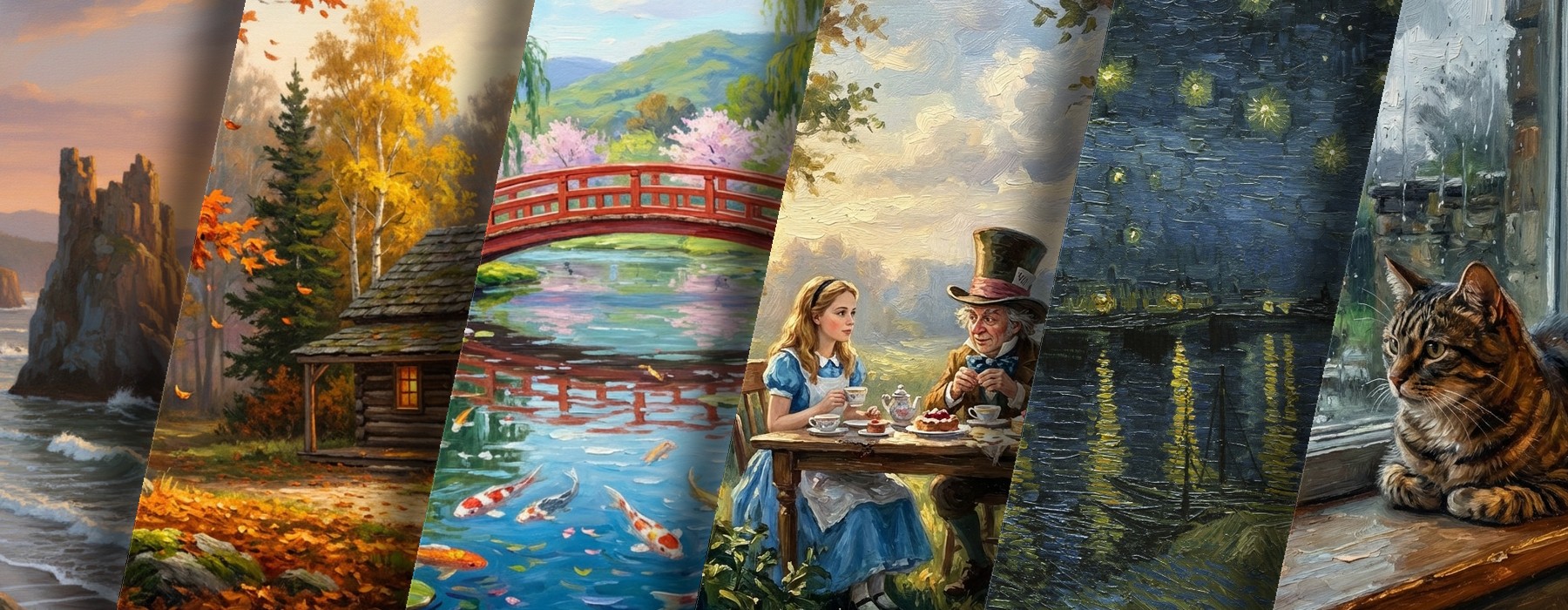
You always pick the same one.
Maybe you don't realize you're doing it. You're browsing puzzles — in a shop, online, at a friend's house — and your hand drifts to the same kind of image every time. Lighthouses. Coastal cliffs. Something with a horizon line and the suggestion of wind.
Or maybe it's the opposite. You reach for the cabin in the woods, the autumn road, the window with rain on the glass. Something enclosed. Something warm.
I notice this because I make puzzles. I've watched my sons choose — the older one goes straight for castles and Japanese gardens, especially bridges and koi ponds, while his brother gravitates toward animals, especially cats. I've watched friends and family reach for the same categories without registering the pattern. And I've done it myself: I reach for landscapes in spring — green fields, open skies, the sense of everything waking up — and until I started paying attention, I had no idea why.
Here's the thing: it's not random. The images you're drawn to in a jigsaw puzzle aren't just aesthetic preferences. They're a kind of self-portrait — a window into what your brain needs when it's trying to rest.
Why You Choose What You Choose
Personality psychologists have known for decades that aesthetic preferences — the art you love, the landscapes that calm you, the environments you seek out — track closely with core personality traits. The most well-validated framework for this is the Big Five model, developed by Robert McCrae and Paul Costa, which maps personality along five dimensions: Openness to Experience, Conscientiousness, Extraversion, Agreeableness, and Neuroticism.
Of these five, Openness to Experience is the single strongest predictor of what visual art a person prefers. People high in Openness are drawn to complex, novel, and abstract images. People lower in Openness prefer the familiar, the representational, the comforting. This isn't a value judgment — it's a description of how brains differ in what they find restorative.
There's a deeper layer, too. The geographer Jay Appleton proposed in 1975 that humans have hardwired landscape preferences shaped by survival: we're drawn to environments that offer either prospect (open views — the ability to see what's coming) or refuge (enclosed, protected spaces — the ability to hide). Rachel and Stephen Kaplan's Attention Restoration Theory added that natural environments restore our capacity for focused attention through what they called "soft fascination" — interest that doesn't demand effort.
Put these together and something clicks. Your puzzle isn't just a picture. It's an environment your brain wants to inhabit for two or three hours. It's the landscape your mind chooses when it needs to recover. We already know that puzzles engage multiple cognitive systems simultaneously — visuospatial reasoning, pattern recognition, working memory. But the image you choose determines the emotional register of that engagement. A lighthouse puzzle and a cozy cabin puzzle both exercise your brain. They rest it in fundamentally different ways.
This explains something that the survey data has been hinting at for years. When Ravensburger and Ipsos surveyed American adults in 2018, they found that 59% of puzzlers cite relaxation as their primary motivation, and 47% cite stress relief. But "relaxation" is not one thing. The person who relaxes by gazing at a wide-open seascape is doing something neurologically different from the person who relaxes by retreating into a cozy interior. Both are restoring — but they're restoring different things. The image you choose determines the kind of rest you get.
During the pandemic lockdowns, Ravensburger reported that two specific categories surged in demand: scenes of comfort (cozy interiors, warm food, domestic stillness) and scenes of travel (exotic locations, faraway landscapes). People weren't choosing "pretty pictures." They were choosing the environments they'd lost access to — the refuge they couldn't find at home, or the prospect they couldn't reach from their apartment. The data doesn't just suggest that image choice is personal. It suggests that image choice is therapeutic — a form of self-medication so intuitive that most people don't realize they're doing it. This pattern has happened before — during the Depression, puzzle sales surged for similar reasons, offering an affordable refuge when the real world offered none.
That's worth knowing something about.
Seven Puzzler Archetypes
What follows isn't a diagnostic tool. It's a set of observations — drawn from personality research, landscape psychology, and watching a lot of people choose puzzles — about the kinds of images puzzlers gravitate toward and what those preferences tend to say about the person holding the box. Most people will recognize themselves in one or two. Nobody fits neatly into one.
The Horizon Seeker
The images: Lighthouses. Coastal scenes. Open landscapes with long sight lines and big skies.
The psychology: This is Appleton's "prospect" preference in its purest form — the need for an unobstructed view. Horizon Seekers tend to score high in Openness to Experience and often carry a streak of independence. They're the person who opens the windows first thing in the morning, who chooses the restaurant table facing the room, who drives the long way home because the road has a better view.
What it says about you: You process the world by stepping back from it. When things feel cluttered — obligations, noise, decisions — your instinct is to find a vantage point. Not to escape. To see clearly. The lighthouse at the edge of the cliff isn't lonely to you. It's the one structure in the scene that knows exactly where it is.
Your puzzle is a window you built yourself, piece by piece. I know — I keep building mine every spring.
The Nester
The images: Cozy cabins. Autumn roads and golden foliage. Fireside scenes, snow on the roof, lamplight through a window.
The psychology: This is Appleton's "refuge" — the enclosed, warm, protected space. Nesters tend to score high in Conscientiousness and Agreeableness. They value ritual, order, and the feeling of everything being in its right place. The appeal of the cozy cabin puzzle isn't the cabin. It's the feeling of being inside it — blanket, tea, nowhere to be, rain doing its thing outside while you're dry and still.
What it says about you: You build safety for other people. It's what you do — at work, at home, in friendships. Your puzzle time is how you build it for yourself. There's a ritual to it, probably. Same corner of the couch, same lamp, same hour. The world is chaotic. Your puzzle table is not.
I know this archetype well. Most winters and falls, my family shares a puzzle on the floor in front of the fireplace. The boys wander in and out, place a piece, wander off again. My wife — who reaches for trees and mythical creatures, a blend no single archetype captures — is usually the one who keeps the edges moving. The puzzle stays. It's the most stable object in the house.
The Time Traveler
The images: Classic art — Vermeer, Renoir, the Old Masters. Fine art reproductions. Monet's water lilies and haystacks.
The psychology: Very high Openness, especially the facets that personality researchers call Aesthetics and Ideas. Time Travelers aren't just assembling an image — they're studying it. The appeal is beauty plus permanence. A Monet puzzle is three hours of sitting with a painting you'll never own, noticing details you'd walk past in a museum because you were too polite to stand that close for that long.
What it says about you: You believe beautiful things deserve sustained attention. While the rest of us scroll past a painting in half a second, you rebuild it by hand. There's a quiet defiance in that — a refusal to consume art the way algorithms want you to. Every piece placed is a small act of resistance against the idea that nothing is worth lingering over.
Your puzzle is a private museum. Admission is patience.
The Storyteller
The images: Fairy tales. Alice in Wonderland. Illustrated narratives, scenes with characters, worlds with different rules.
The psychology: Very high Openness, especially the Fantasy facet. Storytellers don't see a completed puzzle as a picture — they see it as a scene. There are characters with intentions, doorways that lead somewhere, forests with something waiting in the shadows. The image is a frozen moment in a story that continues in their head long after the last piece clicks.
What it says about you: You've always lived partly in other worlds, and you're not apologetic about it. As a kid you read under the covers with a flashlight. As an adult you still think the best compliment someone can give a book is "I didn't want it to end." Your puzzle isn't decoration. It's an open door.
You're not escaping reality. You're enriching it with narrative. There's a difference, and you've never needed anyone else to understand it.
The Companion
The images: Cats. Dogs. Animals in domestic settings — on windowsills, in gardens, curled up near fireplaces.
The psychology: High Agreeableness — warmth, empathy, the instinct to nurture. The emotional response to animal images is one of the most consistent findings in visual psychology: they activate the same bonding circuits that respond to human faces, especially when the animals are depicted in relaxed, domestic contexts. The Companion doesn't choose a cat puzzle because they "like cats." They choose it because the image radiates the same quality they carry into every relationship — gentle attention, quiet presence, the comfort of familiar company.
What it says about you: You're the person who notices when someone at the table has gone quiet. You remember birthdays. You ask follow-up questions. You probably have strong opinions about which of your pets is being underappreciated at any given moment.
Your puzzle is company. A warm presence on the table while you work. You're never really alone when something is looking back at you from the box lid.
The Challenger
The images: Abstract patterns. Gradients. Monochrome fields. The kind of puzzle where the image is almost irrelevant because the difficulty is the point.
The psychology: High Conscientiousness combined with competitive drive and low Neuroticism — meaning stress-tolerant enough to enjoy being stuck. The Challenger picks the puzzle that most people would avoid: the all-white sky, the gradient that shifts by one shade per row, the cut where every piece looks identical. The satisfaction isn't in the picture. It's in the proof that you could do it.
What it says about you: You need something to push against. Easy things bore you, and you measure your evenings by whether you solved something. Other people puzzle to relax. You puzzle to win — even though the only opponent is the puzzle itself. Especially because the only opponent is the puzzle itself.
You've never once finished a gradient puzzle and thought "that was pleasant." You've thought "I did it." And that was enough.
The Explorer
The images: Japanese gardens. Castles. Architecture from places you've been or places you haven't.
The psychology: High Openness combined with cultural curiosity and a moderate streak of Extraversion. Explorers use puzzles as a form of travel — not in the tourist-brochure sense, but in the slow, absorptive way that you learn a place by paying attention to its details. A Japanese garden puzzle is three hours of being there — noticing the curve of a bridge, the particular green of moss on stone, the way light falls through maple leaves. You're not assembling an image. You're arriving somewhere.
What it says about you: You're curious about places you haven't been and cultures you don't fully understand yet. Your puzzle shelf is a map of everywhere you want to go — or everywhere you've been and want to remember. When someone asks about your last vacation, you describe the light, not the hotel.
You know that the best way to understand a place is slowly. A puzzle teaches that.
My oldest son is an Explorer — but the cerebral kind. He studies a Japanese garden puzzle like a Lego instruction manual: the arc of the bridge, the placement of every stone, the koi moving through a space someone designed on purpose. He's not drawn to the beauty. He's drawn to the order underneath it.
Most People Are Two
If you recognized yourself in more than one archetype — good. That's how personality works. The Big Five model measures spectrums, not boxes. You don't have a personality type the way you have a blood type. You have a personality profile — a blend of tendencies that shift with mood, season, and circumstance. Most puzzlers are a Nester who becomes an Explorer on vacation. A Companion who picks up a Challenger puzzle once a year and spends three weeks regretting it before finishing in a triumphant all-nighter. A Horizon Seeker who, after a brutal week, reaches for the cozy cabin instead of the lighthouse — because this week, refuge matters more than prospect.
The blend is the interesting part. It's the place where you learn something about yourself you didn't know. If you're always a Time Traveler but one day you reach for a fairy tale puzzle, that's not a contradiction. That's your brain telling you it needs story more than beauty right now — narrative more than permanence. Pay attention to the shifts. They're data.
I'm a Horizon Seeker — spring landscapes, open fields, anything with a long view and the feeling that something is beginning. My wife is somewhere between a Storyteller and something the archetypes don't have a name for: trees and mythical creatures, every time, drawn to worlds that are rooted and enchanted at once. Our oldest is a cerebral Explorer — bridges and koi ponds, the order hidden inside beauty. Our youngest is a Companion — animals, always animals, no deliberation required. The four of us, spread across four types, on the floor in front of the same fireplace. There's a lesson in that about how different people rest differently, even when they're resting together.
The fun part isn't sorting yourself into a single category. It's the conversation that happens when you tell someone else which one you are. "You're the Nester, obviously." "I'm offended — I'm at least a Time Traveler." "You're a Companion. Your entire personality is your cat." That exchange — the playful identity negotiation between people who know each other — is the reason this format works. It gives you language for something you've noticed but never named.
If you've read about the secret society of adult puzzlers, you know that half the country does this hobby without talking about it. Part of the reason is that we never had the vocabulary. "I do puzzles" doesn't tell anyone much. "I'm a Horizon Seeker" tells them everything.
You've always known your type. You just didn't know it was a type.
Find Your Type
Now that you know what your puzzle choice says about you, the only question left is whether you'll lean into it or branch out.
If you're a Horizon Seeker, start with lighthouses or coastal scenes. If you're a Nester, the cozy cabins and autumn collection are calling your name. Time Travelers: classic art and Monet. Storytellers: fairy tales and Alice in Wonderland. Companions: cats — you already knew. Explorers: Japan, castles, architecture from around the world.
And Challengers? Browse everything. Pick the one that looks impossible. You know you want to.
Further reading
- McCrae, R. R. & Costa, P. T. — Personality in Adulthood: A Five-Factor Theory Perspective (Guilford Press). The foundational text on the Big Five personality model.
- Appleton, J. — The Experience of Landscape (1975, Wiley). The original prospect-refuge theory: why humans prefer certain environments, and what those preferences reveal.
- Kaplan, R. & Kaplan, S. — The Experience of Nature: A Psychological Perspective (1989, Cambridge University Press). Attention Restoration Theory — why natural settings restore cognitive function.
- Furnham, A. & Walker, J. (2001) — "Personality and Judgements of Abstract, Pop Art, and Representational Paintings," European Journal of Personality. Openness to Experience as the strongest predictor of visual art preference.
- Psychology Today — "What Your Hobbies Say About You (Whether You Like It or Not)" (March 2025). The research on how hobby disclosure signals personality.
- The history of jigsaw puzzles — How puzzle preferences have shifted across 260 years of puzzling.
- Benefits of puzzles for adults — The science behind why puzzles calm the brain and sharpen cognition.
- You belong to a massive secret society — The community of adult puzzlers, and why half the country does this in secret.