The History of the Jigsaw Puzzle: From 1760 to Today
By Nicholas Mathis, Toymaker & Founder of The Wundorium Co.
It starts the same way every time. You open the box, pour the pieces onto the table, and stare at what looks like total chaos. A few hundred — maybe a thousand — tiny cardboard fragments, face-down, scattered, meaningless. And then something in your brain switches on. You flip them over. You find the edges. You begin.
My two sons — five and seven at the time I'm writing this — taught me why that impulse is so strong. They're the best playtesters a toymaker could ask for, which means they break everything I build. But the one thing they never break is a jigsaw puzzle, because a jigsaw puzzle arrives already broken. The whole point is the repair.
That impulse — the urge to make order out of disorder, to find the picture hidden in the mess — is older than you think. People have been doing this for over 260 years. The jigsaw puzzle has survived revolutions, depressions, world wars, the rise of television, the internet, and smartphones. It keeps coming back. Understanding why means going back to the very beginning: a print shop off Drury Lane in 1760s London, where a young mapmaker had an idea that would outlast him by centuries.
A Mapmaker's Invention
John Spilsbury was born in 1739, the second of three sons in a family of engravers and printers. At fourteen, he began a seven-year apprenticeship under Thomas Jefferys, the Royal Geographer to King George III — one of the most respected cartographers in England. By the time he finished, Spilsbury was a skilled engraver with an intimate knowledge of maps and the world they depicted.
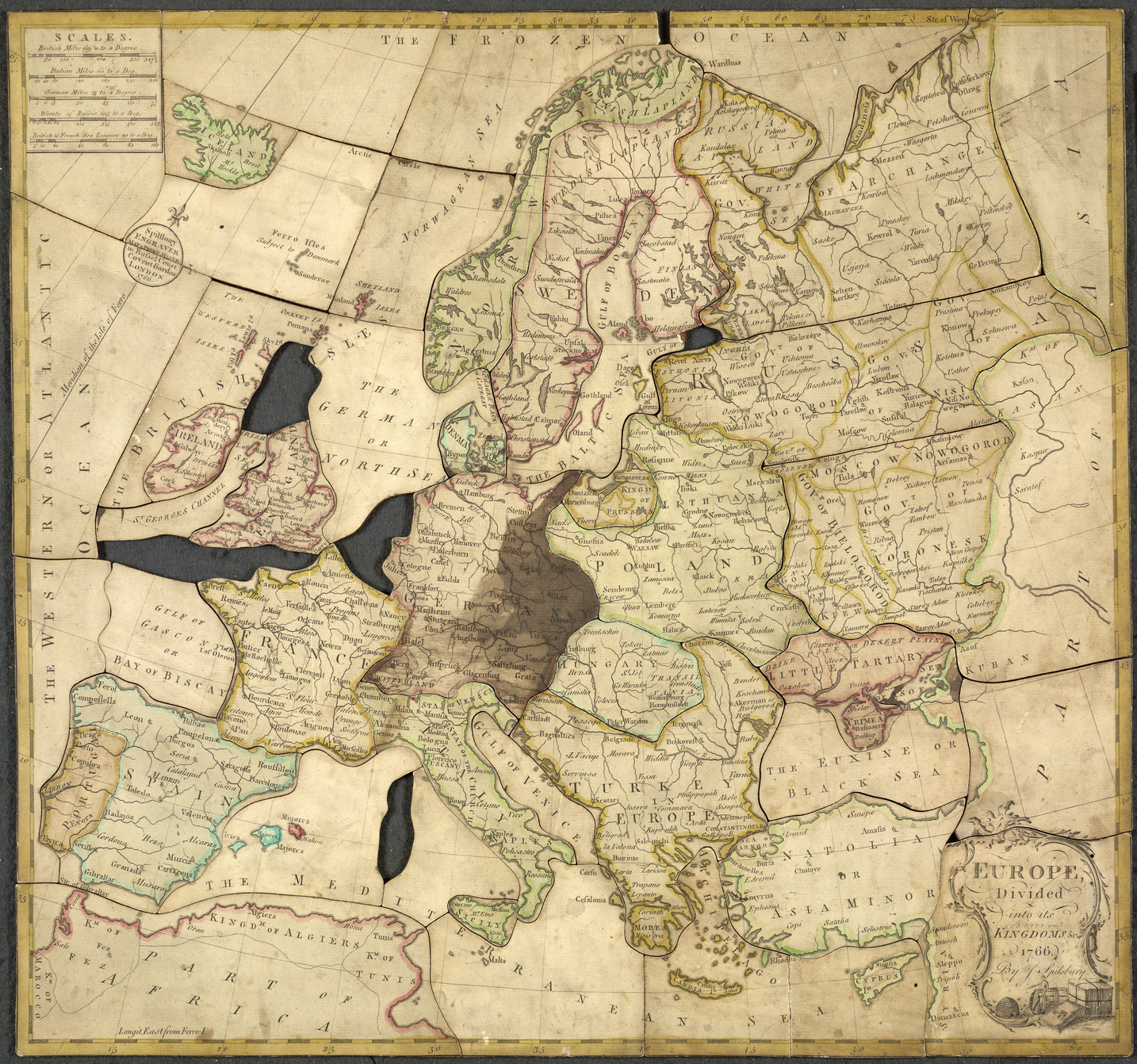
Sometime in the early 1760s, Spilsbury had a deceptively simple idea. He pasted an engraved map of Europe onto a thin sheet of mahogany and cut along the borders of each country with a marquetry saw. The result was a set of individual pieces — France, Spain, the German states, the Italian peninsula — that could be jumbled together and reassembled. He called them "dissected maps."
The concept wasn't purely entertainment. This was the age of Enlightenment-era education reform. Philosophers like John Locke had argued decades earlier that children learned best through play, not rote memorization. Spilsbury's dissected maps fit squarely into that philosophy: children would absorb geography — the shapes of nations, the relationships between borders — by physically handling the pieces and fitting them back together.
I think about Locke's idea often. I'm a toymaker and a stay-at-home father, and one of the most valuable things I've learned is that my children's best learning moments rarely come from the toys that work perfectly. They come from the ones that break. A toy I spent weeks crafting gets "playtested" into pieces — and instead of a disaster, it becomes a new kind of toy. We go into the workshop together. We look at how it broke and why. We pick out the right glue, find the right clamp, learn what mahogany does that pine doesn't. They're learning about materials, tools, cause and effect — but it doesn't feel like a lesson. It feels like fixing something. Spilsbury understood that instinct two and a half centuries ago: give a child a broken map of Europe and let them put it back together, and they'll learn more geography in an afternoon than a week of lectures could teach.
Spilsbury set up shop at Russell Court in London and advertised himself as an "Engraver and Map Dissector in Wood, in order to facilitate the Teaching of Geography." His trade card listed around thirty different dissected maps for sale, organized into eight themes: the World, Europe, Asia, Africa, America, England and Wales, Ireland, and Scotland. Prices ranged from seven shillings and sixpence to a full guinea — expensive by any measure. At a time when the average English worker earned one to two shillings per day, these were luxury goods.
And they found a luxury audience. Lady Charlotte Finch, the Royal Governess, used Spilsbury's dissected maps to teach the children of King George III and Queen Charlotte. The King himself was such an advocate that he had a special mahogany cabinet built to store his children's growing collection. Elite boarding schools placed orders. Wealthy families across England followed the royal example.
Spilsbury didn't live to see how far his invention would travel. He died on April 3, 1769, at just twenty-nine years old. His wife Sarah took over the business and later married Harry Ashby, one of Spilsbury's former apprentices, who continued producing dissected maps. But the idea had already escaped the confines of a single shop. By the end of the eighteenth century, London was home to nearly twenty puzzle makers, and the concept had spread across Europe.
Jane Austen captured the cultural status of dissected maps in Mansfield Park, published in 1814. When the impoverished Fanny Price arrives at her wealthy relatives' estate, her cousins mock her mercilessly: "Dear mama, only think, my cousin cannot put the map of Europe together." In Austen's world, knowing your way around a dissected map was a mark of proper breeding — and not having that knowledge was a source of shame.
From Schoolroom to Living Room
For roughly a century after Spilsbury, puzzles remained primarily educational tools for children. Makers expanded the subject matter beyond geography — puzzles depicting the chronology of English monarchs, Biblical stories, moral tales, and alphabet lessons all appeared throughout the late 1700s and early 1800s. But the essential concept held: puzzles were for learning, and they were for the young.
That changed in the second half of the nineteenth century. Several technological shifts converged to transform the puzzle from a classroom aid into an adult pastime.
The first was the treadle-powered fretsaw, which appeared around 1880. Before this, every puzzle had to be cut entirely by hand with a marquetry saw — slow, painstaking work. The treadle saw, operated with a foot pedal like an old sewing machine, allowed makers to produce more intricate cuts at faster speeds. Puzzles could now have more pieces, more complex shapes, and finer detail.
The second was plywood. Early puzzles were cut from solid hardwoods like mahogany and cedar — beautiful but expensive. Plywood, which became widely available in the late 1800s, was cheaper, lighter, and easier to cut. It opened up puzzle production to a much wider range of makers.
The third was the revolution in color printing. Chromolithography made it possible to reproduce vivid, full-color images at scale. Puzzles were no longer limited to maps and line engravings. Landscapes, pastoral scenes, ships, and fine art reproductions began appearing on puzzle faces, making them far more appealing as entertainment.
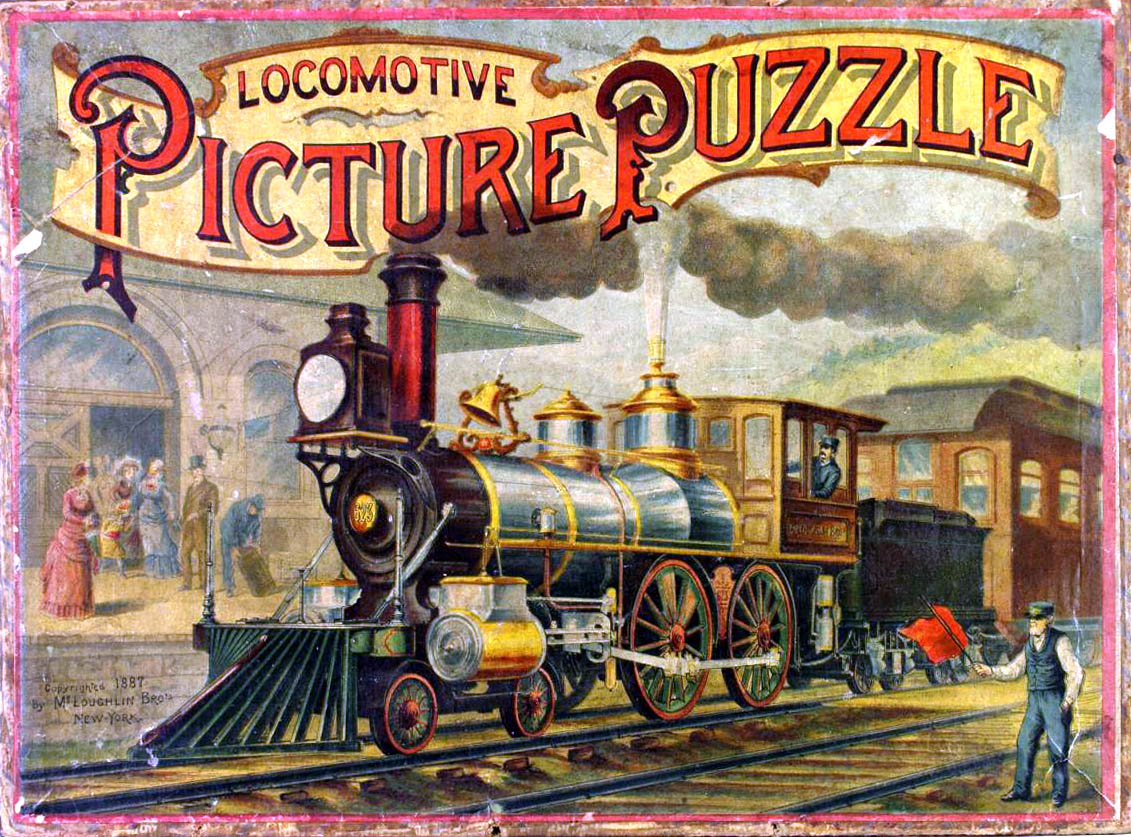
Interestingly, the word "jigsaw" entered the picture around this same period — the 1880s — but it's something of a misnomer. The treadle saws that puzzle makers actually used were fretsaws, not jigsaws. The two tools are different. But "jigsaw puzzle" rolled off the tongue better than "fretsaw puzzle," and the name stuck. The term "jigsaw puzzle" itself didn't appear in print until 1906.
Cardboard puzzles also arrived in the late 1800s, though they were initially viewed as cheap and inferior — suitable for children, perhaps, but not for serious puzzling. Wooden puzzles carried prestige and, not coincidentally, much higher profit margins for manufacturers. This perception would hold for decades.
The First Craze: 1907–1911
The first true jigsaw puzzle craze hit the United States between 1907 and 1911, and it hit hard.
A May 1908 headline in The New York Times captured the mood: "New Puzzle Menaces the City's Sanity. Young and old, rich and poor, all hard at work fitting cut-up pictures together." The article noted that solitaire had been abandoned and that clergymen, a Supreme Court justice, and prominent financiers had all fallen under the puzzle's spell. President Theodore Roosevelt was reportedly an enthusiast, as were Czar Nicholas II of Russia and the financier J.P. Morgan.
Puzzle historian Anne D. Williams — a professor emerita of economics at Bates College and the leading authority on the subject — attributes this first craze to several converging factors: a shaky U.S. economy in 1907, increased leisure time among upper- and middle-class women, and the growing availability of powered scroll saws that made puzzle production more accessible.
In 1908, Parker Brothers introduced its "Pastime" puzzle line from its factory in Salem, Massachusetts, featuring pieces cut into the shapes of animals, letters, and other recognizable figures — what collectors now call "whimsy pieces." Pastime puzzles were so wildly successful that Parker Brothers temporarily halted all other game production and devoted its entire factory to puzzles. The company employed teams of women cutters — "Pastime girls," they called them — to produce the intricate pieces. Parker Brothers claimed women were better suited to the work because of their smaller hands, but the real reason, as Williams has noted, was that they could pay women far less than men. Cutters were paid by the piece and expected to produce at least 1,400 individual pieces per day.
But despite the Times headline's democratic claim of "young and old, rich and poor," puzzles during this first craze were largely a pastime of the wealthy. A 500-piece wooden puzzle cost roughly $5 in 1908 — about 10% of the average worker's monthly income. Puzzle rental libraries and exchange clubs sprang up to make the hobby more accessible, but for most Americans, puzzles remained a luxury.
The craze faded by 1911 for reasons that aren't entirely clear. But the puzzle had crossed a permanent threshold. It was no longer just a children's educational toy. It was an adult pastime — one that was poised to explode.
Ten Million a Week: The Great Depression
If the first craze was a tremor, the Great Depression was an earthquake.
As unemployment soared past 25 percent in the early 1930s, Americans found themselves with a devastating surplus of time and a devastating shortage of money. They needed something — anything — to fill the hours, to occupy the mind, to provide some small sense of accomplishment in a world that seemed to be falling apart. Jigsaw puzzles were the answer.
The key innovation that made this possible was the die-cut cardboard puzzle. New manufacturing techniques allowed companies to stamp out hundreds of thousands of puzzles using hardened steel dies pressed into paperboard — the same basic process used today. Production costs plummeted. A 300-piece puzzle could now sell for as little as twenty-five cents, putting puzzles within reach of nearly every American household for the first time.
The scale of the puzzle mania is almost hard to believe. By early 1933, American manufacturers were producing an estimated ten million puzzles per week, flowing into thirty million households. Newsstands sold weekly puzzle releases the way they sold magazines — a new design every Wednesday, twenty-five cents apiece — and people rushed to buy them and be the first among their friends to finish that week's challenge. Series titles like "Jig of the Week," "Picture Puzzle Weekly," and "Movie Cut-Ups" competed for shelf space.
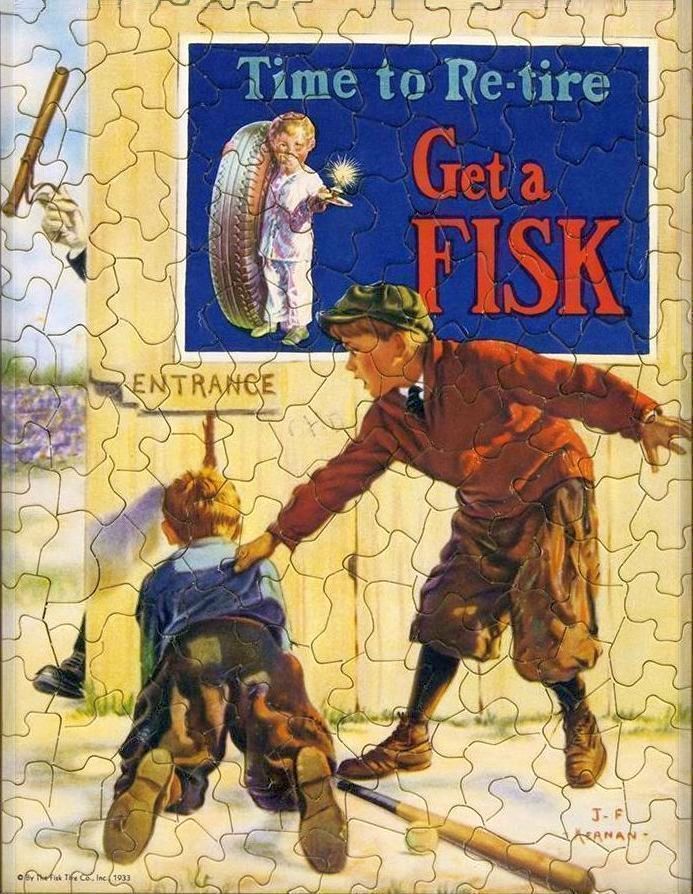
Businesses discovered that puzzles were irresistible marketing tools. In June 1932, the Prophylactic Brush Company of Massachusetts offered a free fifty-piece puzzle with every toothbrush purchase. The promotion was a runaway success, and hundreds of other companies followed suit — giving away puzzles, embedding brand imagery into puzzle designs, and turning the craze into a commercial bonanza.
Meanwhile, thousands of unemployed workers turned puzzle-making into a livelihood. You could buy a scroll saw for as little as $5, set it up in your kitchen or basement, and start cutting and selling puzzles to neighbors — or renting them out through the local drugstore. Puzzle lending libraries popped up in towns across the country, offering rentals for five or ten cents a night.
The images on Depression-era puzzles tell their own story. As puzzle historian Amy Pepe has written, the pictures were overwhelmingly "nostalgic, romantic, and exotic — an antidote for the hard times." Lighthouses, English cottages, seascapes, faraway landscapes. Movie stars and scenes from the Chicago World's Fair appeared on puzzle faces, but the economic catastrophe itself was conspicuously absent. Puzzles were an escape, and the pictures reflected that.
Anne Williams captured the deeper psychology at work: "It's something you can control, whereas they felt that their lives were totally out of control as far as the economy went. It's also a challenge over which you can prevail."
I stumbled onto a version of this in my own work. When I started building Wundorium, I had ideas about what I wanted to make — strange and surreal images, fantasy scenes, abstract art. Then I looked at what people actually search for. The data told a different story. The most-searched puzzle subjects, month after month, are lighthouses, autumn foliage, cozy cabins, castles, Japanese gardens, Monet's water lilies. Not a single trending topic in the list. Not a single thing ripped from the news. Ninety years after the Depression, and the images people reach for when they want a puzzle are still nostalgic, still romantic, still an escape. The medium has changed — cardboard to screen, newsstand to search engine — but the impulse hasn't moved an inch.
That insight — that puzzles offer a rare sense of agency in chaotic times — would prove prophetic, again and again, across the century to come.
War, Cardboard, and the Modern Puzzle
World War II brought a modest resurgence of interest in puzzles, driven by wartime rationing of other entertainment options. But it also brought a permanent shift in materials. Plywood was diverted to the war effort, and cardboard — once considered the cheap, inferior option — became the standard. After the war, improved manufacturing processes made paperboard puzzles more attractive than ever, while rising labor costs made hand-cut wooden puzzles increasingly unaffordable for most buyers.
The postwar decades saw puzzles settle into a steady, less frenzied existence. They were no longer a national obsession, but they never went away either. Companies like Springbok, founded in 1963, pushed the art of puzzle design forward by licensing fine art reproductions and introducing round puzzles and other novel shapes. Milton Bradley and Parker Brothers continued mass production. And a handful of artisan makers — most notably Par Puzzles, whose co-founders set the gold standard for hand-cut wooden puzzles — kept the high-end craft alive until the last founder died in 1974.
The late twentieth century brought three-dimensional puzzles (Wrebbit's 3D architectural puzzles became a sensation in the 1990s), puzzles with no edge pieces, double-sided puzzles, mystery puzzles with no box image, and eventually, digital puzzles that could be played on a computer screen.
Through it all, the basic cardboard jigsaw puzzle remained the backbone of the industry. The manufacturing process that emerged in the 1930s — printing an image on paperboard, then pressing a custom steel die through it to punch out the pieces — is still fundamentally the same process used today. Think of a giant cookie cutter shaped like a thousand interlocking puzzle pieces, pressed through cardboard with a hydraulic press. Simple, efficient, and endlessly repeatable.
The Pandemic Puzzle Boom
Then came 2020, and history repeated itself in ways that would have made Anne Williams smile.
When COVID-19 lockdowns sent millions of Americans home in March 2020, the demand for jigsaw puzzles surged in a way that hadn't been seen since the Great Depression. Ravensburger, Europe's largest puzzle manufacturer, reported that U.S. sales jumped 370 percent year over year. The company had sold roughly seven puzzles per minute in North America in 2019; by spring 2020, that figure had tripled to twenty per minute. Ceaco, one of the largest American puzzle makers, reported sales at major retailers were up 300 percent in a single week. Buffalo Games saw in-store purchases leap from $120 million to $250 million.
Puzzle sections at Target and Walmart were stripped bare. Amazon's search rankings showed "puzzles for adults" climbing into the top ten most-searched items, sitting alongside toilet paper and cleaning supplies. Some retailers engaged in price gouging, reselling puzzles online for double or triple the retail price. Puzzle Warehouse, an online retailer, hired thirty additional employees to handle a tenfold increase in orders and still couldn't keep up.
The parallels to the 1930s were uncanny — and the psychology was identical. Marcel Danesi, a professor of semiotics at the University of Toronto and author of The Puzzle Instinct, explained it this way: "There is always a sense of chaos within us, due probably to the fact that life is so unpredictable. Puzzles do have answers and reaching them provides a kind of instant and temporary relief from the angst."
The pandemic also highlighted something new about the puzzle world: it had quietly been growing even before COVID hit. Ravensburger reported record sales of €524 million in 2019, capping five consecutive years of growth. A 2018 survey found that roughly half of Americans puzzled at least once a year. The lockdowns didn't create a trend — they poured gasoline on one that was already smoldering.
Speed Puzzling and the Competitive Scene
Perhaps the most surprising development in the puzzle's long history is the emergence of competitive speed puzzling as a legitimate sport.
The World Jigsaw Puzzle Championship launched in 2019 in Valladolid, Spain, organized by the newly formed World Jigsaw Puzzle Federation and sponsored by Ravensburger. Competitors from dozens of countries race to complete 500- and 1,000-piece puzzles in individual, pairs, and team formats. The times are staggering: in 2024, Norway's Kristin Thuv won the individual title by completing a 500-piece puzzle in just 37 minutes and 58 seconds.
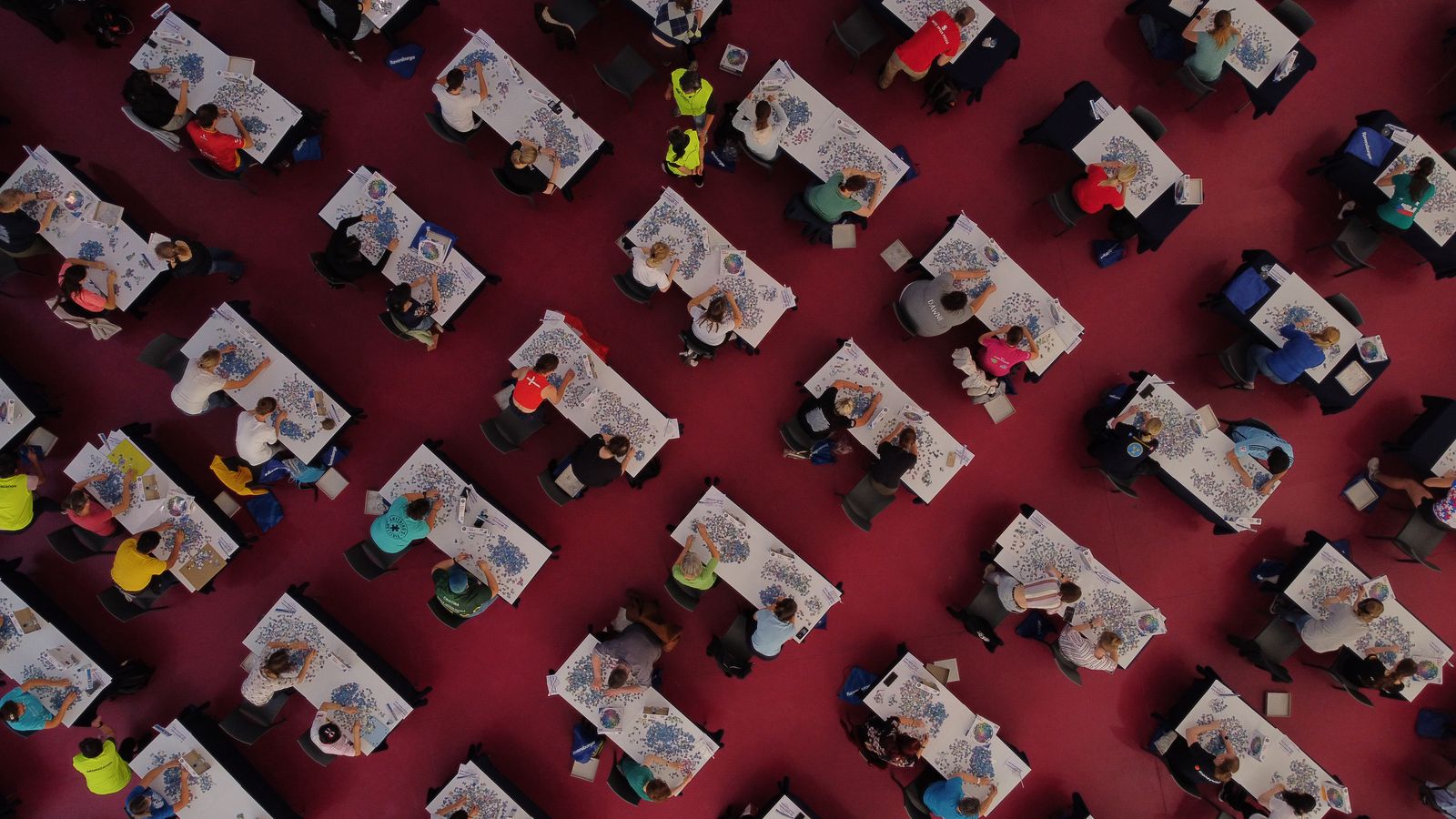
The championships have grown rapidly. The 2024 edition drew competitors from around 40 countries. National associations — including the USA Jigsaw Puzzle Association, founded in 2020 by five puzzlers who connected online during the pandemic — now organize regional and state competitions that feed into the world championships. Speed puzzling events have appeared at conventions, community centers, and even bars.
It's a remarkable development for a pastime that spent most of its history as the definition of quiet, solitary leisure. But it also makes a certain kind of sense. The puzzle has always adapted to the needs of its era. In the 1760s, it was an educational tool. In the 1900s, a high-society diversion. In the 1930s, cheap therapy. In 2020, a lifeline. In the 2020s, a spectator sport. The format changes; the fundamental appeal doesn't.
Why Puzzles Endure
There's a question that runs underneath the entire 260-year history of the jigsaw puzzle, and it's worth asking directly: why do these things persist?
Television didn't kill them. Video games didn't kill them. Smartphones didn't kill them. Every new technology that was supposed to make analog pastimes obsolete has come and gone, and jigsaw puzzles have not only survived but repeatedly surged back to cultural prominence. There has to be something deeper going on.
Part of it is tactile. We live in an age of screens and abstraction, and there is something profoundly satisfying about picking up a physical piece, feeling its edges, rotating it in your fingers, and hearing that small, decisive click when it snaps into place. Marcel Danesi calls this "the re-integration of body and mind" — and argues that younger generations, raised entirely on screens, are especially drawn to it.
Part of it is psychological. A jigsaw puzzle is a problem with a guaranteed solution. In a world where most of the problems we face — political, economic, personal — are ambiguous, contested, and often unsolvable, a puzzle offers the rare promise that if you just keep going, the picture will emerge. Every piece placed is genuine progress. Every section completed is a small, uncomplicated victory.
And part of it is social. Despite its reputation as a solitary activity, puzzling has always had a communal dimension. Depression-era families gathered around the kitchen table. Pandemic households turned puzzling into a shared project. Puzzle swap groups, online communities, and now competitive events have created networks of people who bond over a shared love of fitting pieces together.
I think about this every time I watch my sons do one of the puzzles I've built. They're the same kids who reduce my hand-crafted toys to spare parts within a week — but hand them a puzzle and something shifts. The younger one gravitates toward the cat puzzles, which tracks, because no one in the history of this family has ever loved cats more than he loves ours. The older one picks spring and summer scenes "because they are so beautiful." They go quiet. They scan, rotate, try, fail, try again. And when the last piece clicks into place, they look up with a satisfaction I recognize from every era of this history: the simple, ancient pleasure of taking something broken and making it whole again.
That's what Spilsbury's students felt in 1767. That's what families gathered around their kitchen tables felt in 1933. That's what millions of locked-down Americans felt in 2020. The picture was in pieces. Now it isn't. Something that was wrong is right.
The core experience translates to a screen more directly than you might expect. The visual scanning, the pattern recognition, the gradual emergence of a complete image from scattered fragments — all of that works in a browser, too. What changes is the context, not the impulse. You might do a puzzle from our Alice in Wonderland collection on your lunch break, or work through a landscape puzzle on a rainy Sunday afternoon, and the feeling of making order from chaos is the same feeling John Spilsbury's students had when they slotted France back into place.
The jigsaw puzzle began as a geography lesson for the children of kings. It became a parlor game for the wealthy, a lifeline for the unemployed, a comfort for the isolated, and now, a competitive sport. Along the way, it never stopped being what it was in the beginning: a simple, elegant challenge — a picture, broken into pieces, waiting to be made whole.
That's not a bad metaphor for just about anything worth doing.
Further Reading
Much of the historical detail in this post draws on the work of Anne D. Williams, a professor emerita of economics at Bates College and the foremost authority on jigsaw puzzle history. Her book The Jigsaw Puzzle: Piecing Together a History (2004) is the definitive English-language account — exhaustively researched, surprisingly fun to read, and the single best source on everything from Spilsbury's shop to the Depression-era craze. If this article interested you, that book will consume you.
Amy Pepe's essays on the Historic Geneva blog offer an excellent deep dive into America's three puzzle crazes, with particular focus on the Depression and pandemic eras. The Victoria and Albert Museum holds one of Spilsbury's original 1767 dissected maps of England and Wales in its permanent collection — you can view it online. And for anyone curious about the competitive side, the World Jigsaw Puzzle Federation and the USA Jigsaw Puzzle Association are the best starting points.
Want to try your hand at some puzzles? Browse our collections — from classic art to fantasy worlds — and play right in your browser. No scissors, no mahogany, no missing pieces under the couch.