You Belong to a Massive Secret Society
By Nicholas Mathis, Toymaker & Founder of The Wundorium Co.
Half the country does jigsaw puzzles — almost nobody admits it.
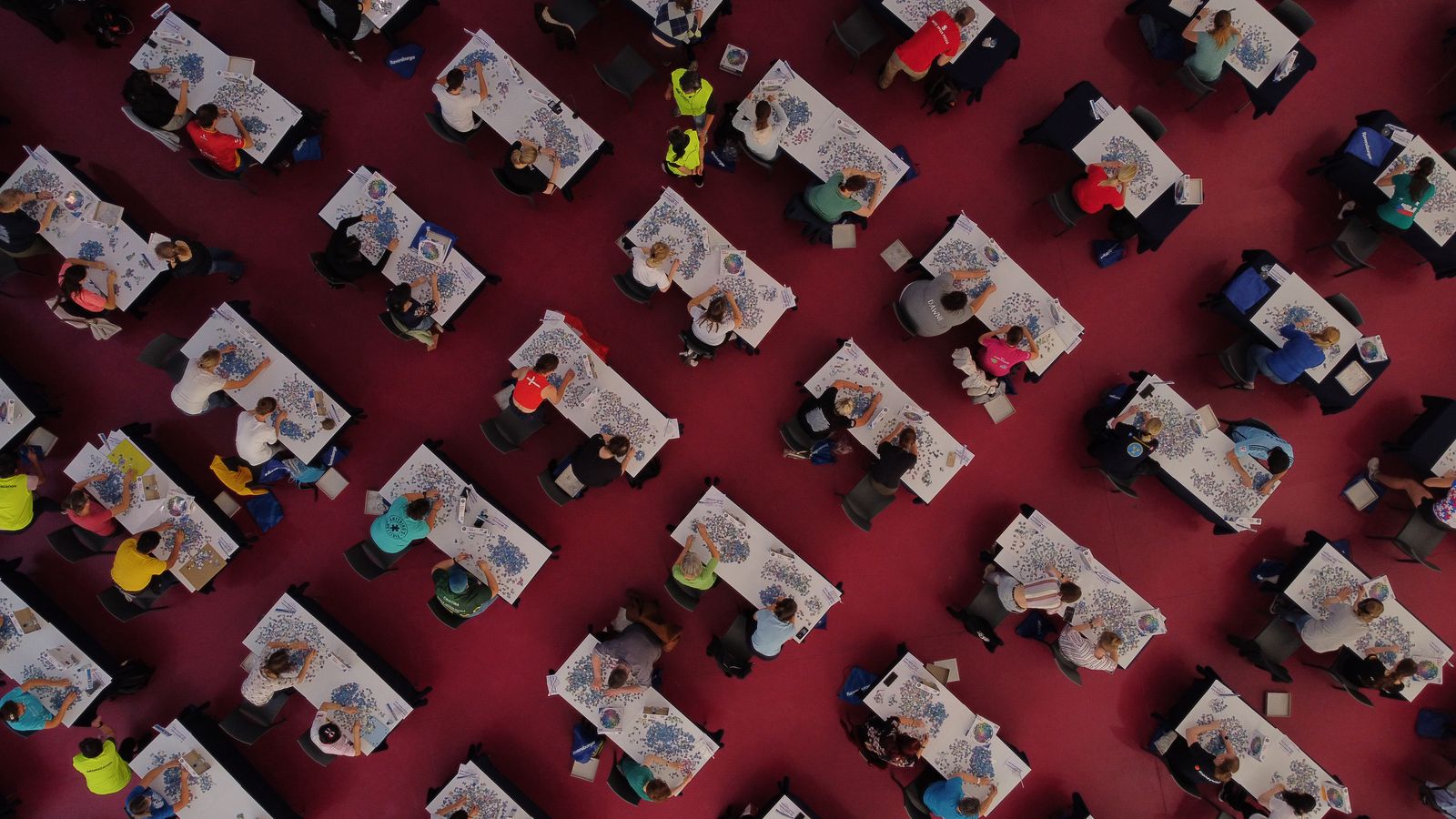
Here's a number that should surprise you: 48% of American adults do jigsaw puzzles at least once a year. That's a hundred and twenty-five million people. Half the country.
Now: when was the last time someone at a dinner party asked "So, what puzzle are you working on"?
I'm a toymaker. I know how popular puzzles are — the data is overwhelming, and it's precisely why I made jigsaw puzzles the foundation of my brand. And I still hesitate when someone asks what I'm working on. There's this half-second calculation: do I say "I'm making online jigsaw puzzles," or do I say "I'm working on some new toys" and hope the conversation moves on? I usually pick the second one. Or I scan for something else I'm doing that wouldn't sound quite so much like an admission.
I've started noticing something else, though. About one in three times, the other person says: "Oh, I love puzzles." Not loudly. Not the way someone would say they're into hiking or cooking or running marathons. More like a wink with a hint of surprise and validation.
This article is about that. It looks closer at the strange cultural silence around a hobby that, according to the data, is one of the most popular pastimes in America. And it's about what happens when you realize the thing you've been slightly embarrassed about is something a hundred and twenty-five million other people are doing, too.
125 million people, zero cultural footprint
In 2018, Ipsos conducted a nationally representative survey of 2,011 American adults, commissioned by Ravensburger. The findings should have been front-page news for anyone in the puzzle industry. They weren't, because the puzzle industry doesn't really have a front page.
Here's what the data showed, and I want you to sit with each one for a second, because they stack:
48% of American adults do jigsaw puzzles at least once a year. Not "have done one at some point." Actively do them.
Millennials puzzle more than Boomers. A YouGov survey found that roughly 70% of Millennials enjoy puzzles, compared to 62% of Boomers. The generation everyone assumes is glued to their phones is actually more likely to sit down with a thousand cardboard pieces than their parents are.
Gen Z goes hardest of all. Among 18-to-34-year-olds, 34% puzzle at least monthly — the highest rate of any age group. A survey by Bits and Pieces found that Gen Z puzzlers average 3.35 consecutive hours per session. Three and a half hours. That's longer than most movies.
Men puzzle more frequently than women on a monthly basis — 24% vs. 14%, according to the Ipsos data. Overall enjoyment is nearly equal: 71% of women and 68% of men say they enjoy puzzles. The stereotype of puzzling as a "women's hobby" doesn't survive contact with the numbers.
Families with kids puzzle the most. Twenty-eight percent of households with children puzzle monthly, compared to 15% of households without. This tracks with my own experience — my sons are the reason I started building puzzles in the first place. After making jigsaw puzzles for them, we started making them for others as gifts. There's often a coffee table or playroom floor covered in puzzle pieces somewhere in the house.
And when you ask people why they puzzle, the answers are revealing: relaxation (59%), fun (57%), stress relief (47%), mental exercise (42%), and spending time with others (34%). That last number is the one most people don't expect. A third of puzzlers say they do it specifically as a social activity.
So here's the picture: a hobby practiced by half the country, skewing younger than anyone assumes, split evenly across genders, concentrated in families, done for relaxation and connection. By every measure, jigsaw puzzling is one of America's most popular leisure activities.
And yet it has approximately zero cultural footprint. No lifestyle branding. No influencer ecosystem. No equivalent of marathon culture or Peloton culture or even CrossFit culture. Puzzling is massive, and it's invisible.
Why?
The quiet hobby in a loud culture
The stigma has specific roots, and they're worth naming, because you've probably felt every one of them without quite being able to articulate why.
Age coding. Puzzles are culturally associated with two groups: small children and the elderly. The image that comes to mind is a toddler with chunky wooden pieces or a grandmother in a nursing home. If you're a 34-year-old software engineer who spent last Sunday doing a 1,000-piece landscape, that image doesn't include you — even though the data says you're the most common type of puzzler.
Productivity culture. Puzzling produces nothing. You spend three hours assembling an image that already exists on the box lid, and when you're done, you break it apart and put it back. In a culture that valorizes visible output — the marathon medal, the sourdough loaf, the home renovation before-and-after — sitting quietly with a thousand pieces feels like something that needs to be justified. You can't post a PR. You can't show a finished product. You just... did a puzzle.
No lifestyle branding. Gaming has Twitch. Cooking has Food Network and a thousand Instagram accounts. Running has Nike, Strava, and the entire marathon industrial complex. Even knitting had a cultural reclamation moment. Puzzling has had none of this. Until very recently, there was no "puzzle influencer" ecosystem, no aspirational visual language, no way to signal "I'm a puzzler" the way you might signal "I'm a runner" or "I'm a home cook." The hobby existed in a branding dead zone.
The whisper. Patrick Stewart — Captain Jean-Luc Picard, Professor Charles Xavier, one of the most distinguished actors of his generation — captured it perfectly. When asked about his puzzling habit, he told an interviewer: "At first I was a little embarrassed about it, as it was something I'd done as a kid. But when I would occasionally mention it, people would whisper: 'Oh, you do jigsaw puzzles, too?'"
The whisper is the diagnostic tool. People don't whisper about acceptable hobbies. Nobody whispers "oh, you run marathons too?" or "oh, you also cook?" They whisper about things they think they're not supposed to do. They whisper about things they haven't quite given themselves permission to claim.
I know this because I did the same thing. I'm a toymaker who chose puzzles as the foundation of an entire brand — because the numbers said it was the right call. And when people asked what I was working on, I'd say "some new toys" and leave it there. If they pressed, I might mention a web platform, or a gaming thing. Both technically true. Both carefully steering around the word "puzzle." Because I knew what would happen if I said it. The flicker. The recalibration.
Here's what I didn't know: I was hiding something that a hundred and twenty-five million people were hiding too.
Patrick Stewart's staircase
Patrick Stewart keeps fourteen completed 1,000-piece puzzles framed on the staircase of his Brooklyn brownstone. He showed them on The Graham Norton Show during the COVID lockdowns — including a Frank Stella abstract that he said "took weeks." He has called puzzling "a secret society" and described the moment of discovering fellow puzzlers with the kind of conspiratorial glee you'd normally associate with finding out someone shares your taste in obscure music.
This is not a man who needs to justify his hobbies. He has two Oliviers, a Golden Globe, a knighthood, and the love of multiple generations of science fiction fans. And yet: "At first I was a little embarrassed about it."
He's not alone.
Hugh Jackman documented a four-month puzzle project on Instagram — not as a bit, not as a joke, but as a genuine obsession he wanted to share. When he finished, he posted a video of himself dramatically dismantling the completed puzzle, piece by piece, with the visible reluctance of someone destroying something they'd invested real time in.
Jamie Dornan and Stanley Tucci were photographed doing puzzles together on New Year's Eve. Tobey Maguire described being introduced to competitive speed puzzling by a friend, and admitted to The Hollywood Reporter that he was immediately hooked. Drew Barrymore has said, simply: "I've never met a puzzle I didn't like."
Rhea Seehorn — Kim Wexler on Better Call Saul — shared a photo of herself puzzling after her Golden Globe nomination. Not celebrating. Not at a party. Puzzling. Her way of processing gratitude, she said.
The point isn't a celebrity catalog. The point is the pattern. These are among the most famous, most publicly scrutinized people on earth. They have access to literally any leisure activity money can buy. And they choose puzzles — and even they frame it slightly apologetically, slightly confessionally, as though they've been caught doing something they weren't sure they were allowed to enjoy.
If Patrick Stewart felt the need to whisper, your hesitation makes perfect sense. And it's completely unnecessary.
From the living room to 28 cities
Here's where the story pivots. Because while millions of people were quietly puzzling in private, something else was happening: the secret was getting out.
According to Eventbrite data reported by Axios, speed puzzling competitions in the United States grew by 151% between August 2024 and July 2025. SpeedPuzzling.com now organizes events in eighteen states — Texas, Georgia, New York, Colorado, Connecticut, Washington, Massachusetts, North Carolina, Illinois, and more. Events sell out consistently.
If you haven't seen a speed puzzling competition, here's how it works: teams of two or four sit at tables. Each team receives a sealed bag containing a 500-piece puzzle — they don't know the image until the countdown begins. A timer starts. The room erupts into focused, slightly frantic activity. There's the collective groan when someone opens their bag and sees what they're dealing with. There's the tense silence of deep concentration. And then, somewhere in the room, a team shouts "Done!" and the clock stops. Times for a 500-piece team puzzle run as low as forty-five minutes.
Michael Driscoll, who organizes speed puzzling events through Puzzle Buzz, was asked by an Axios reporter if he ever imagined puzzling would become this popular. His answer: "Hell no."
Many of the people showing up to these events trace their start to the same place. Kristian Powell, an Indianapolis puzzler profiled by Axios, describes how it began during COVID: she and her friends would each buy the same puzzle on Amazon, get on a Zoom call, and race to finish over snacks and wine. When lockdowns lifted, the Zoom calls became in-person meetups. The meetups became organized competitions. Now she competes regularly with a rotating team of coworkers.
This pattern — pandemic isolation breeding a puzzle habit that eventually became social — has happened before, and it played out thousands of times, in thousands of living rooms, across the country. Libraries picked it up. Carmel Clay Public Library in Indiana has run annual puzzle competitions since 2023. Hamilton East Public Library hosts "Puzzle Showdown." Coffee shops started hosting puzzle nights. What began as a private coping mechanism during the worst of the pandemic became, for many people, the foundation of a real community.
The scale goes global. The World Jigsaw Puzzle Championship, organized by the World Jigsaw Puzzle Federation and hosted in Valladolid, Spain, drew competitors from 65 countries in 2025. The 2026 edition is scheduled for September. The USA Jigsaw Puzzle Association — founded in 2020 by five puzzlers who connected online during the pandemic — now organizes national championships and serves as the official U.S. liaison to the world federation.
Online, the community was already thriving. The r/JigsawPuzzles subreddit has roughly 86,000 members — the largest jigsaw-specific forum on the internet. Members post completions, debate brands, swap puzzles, and share the specific mishap every puzzler dreads: the missing piece discovered after the box is sealed. Facebook groups like Jigsaw Puzzle Lover have tens of thousands of members. Puzzle swaps happen at libraries, community centers, and museums.
None of this is what you'd expect from a hobby that supposedly belongs to grandmothers.
There's a broader cultural context, too, though it's worth keeping in proportion. TikTok influencers declared 2026 "the year of analog." Google Trends shows searches for "analog hobbies" up 160% in thirty days. The "analog bag" trend — a curated tote of non-digital pastimes — specifically includes puzzles. "Grandma hobbies" are being rebranded as self-care and anti-doomscrolling tools by outlets from Today to Psychology Today.
But here's the framing that matters: the analog trend didn't create puzzlers. It gave them permission to stop whispering. Puzzling wasn't being reclaimed — it was never gone. A hundred and twenty-five million people were already doing it. The cultural moment just gave them language to talk about it.
Welcome to the not-so-secret society
I stopped dodging about a month ago. One of the other parents at my kids' preschool asked what I was working on, and instead of the usual "some new toys" — I said: "I make jigsaw puzzles. Online ones. You play them in your browser."
The flicker happened, same as always. The recalibration.
And then: "Wait, really? I love puzzles."
That's what happens when you stop treating it like a confession. It becomes a conversation. And the conversation reveals what the data already showed: you are not the outlier. You are the majority.
Half the country does jigsaw puzzles. Patrick Stewart frames his on the wall. Speed puzzling competitions are selling out in eighteen states. A subreddit of 86,000 people is posting their completions every single day. The World Championship draws competitors from 65 countries. And you — sitting there with your cozy cabin scene or your fine art reproduction or your cat puzzle that you do after the kids are in bed — you're part of all of it. You always were.
The secret society was never actually secret. It was just quiet.
So: welcome. You belong here. And if you're looking for your next puzzle — or your first — browse our collections and see what catches your eye. You might discover something about what your puzzle choice says about you.
You don't have to whisper anymore.
Sources
- Ipsos. (2019). "Puzzle Fun: How America Pieces It Together." National survey of 2,011 U.S. adults, commissioned by Ravensburger. Read on Ravensburger.us →
- YouGov/Statista. (2023). "Puzzle Popularity by Generation." Consumer survey data, Q3 2023.
- Bits and Pieces. (2023). "Puzzle and Stress Survey." Consumer survey on puzzle habits and mental health.
- Axios. (2026). "Speed puzzling is growing fast." Coverage across Indianapolis, Houston, and Atlanta bureaus, March 2026. Reports Eventbrite data showing 151% growth in puzzle competitions.
- World Jigsaw Puzzle Federation. worldjigsawpuzzle.org — 2025 championship results and 2026 schedule.
- USA Jigsaw Puzzle Association. usajigsaw.org — Founded 2020, national championship organization.
- Rest In Pieces: Celebrity Puzzlers. Compiled from Parade, The Graham Norton Show, Cloudberries, Blue Kazoo, Hello, and The Hollywood Reporter.
Nicholas Mathis is a toymaker and the founder of The Wundorium Co. He made jigsaw puzzles the foundation of his brand — and he no longer dodges when people ask what he's working on. Read more: The History of the Jigsaw Puzzle · Benefits of Puzzles for Adults